Incentization to increase intercity delivery fulfullment
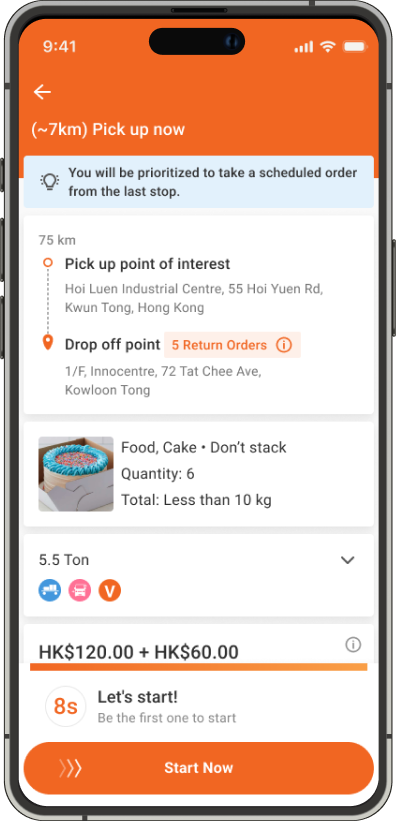
Intercity orders are more efficient to the business since the transaction value per order is higher than that of the overall order. We wanted to maximize the opportunity by ensuring drivers respond and fulfill intercity orders.
↑ 3%
Increase in response rate

↑ 11%
Increase in fulfillment rate

↑ $64K
Increase in est. annual revenue (USD)
Lalamove is an on-demand delivery platform that connects 13 million users with 1.2 million driver partners in 11 markets across the world. Lalamove driver-partner app is a tool for drivers to receive and manage delivery requests from customers.
My role
- Defined the solution with product managers through a workshop
- Designed the user interfaces and experiences for the feature
Opportunity
Though intercity orders are attractive to the business, drivers were not responding or completing the intercity orders. his issue directly impacts customer confidence in our intercity delivery service, creating an urgent need to address these fulfillment gaps.
The opportunity is
How can we attract drivers to deliver intercity orders?
Goal
The goal is to increase the revenue by increasing intercity orders.
The product manager set the goal and success metrics for this feature. We want to target:
- Increase the response rate1 of intercity orders
- Increase the fulfillment rate2 of intercity orders
- Response rate is a percentage of orders that drivers voluntarily respond to placed orders
- Fulfillment rate is a percentage of orders that drivers complete placed orders

Steps
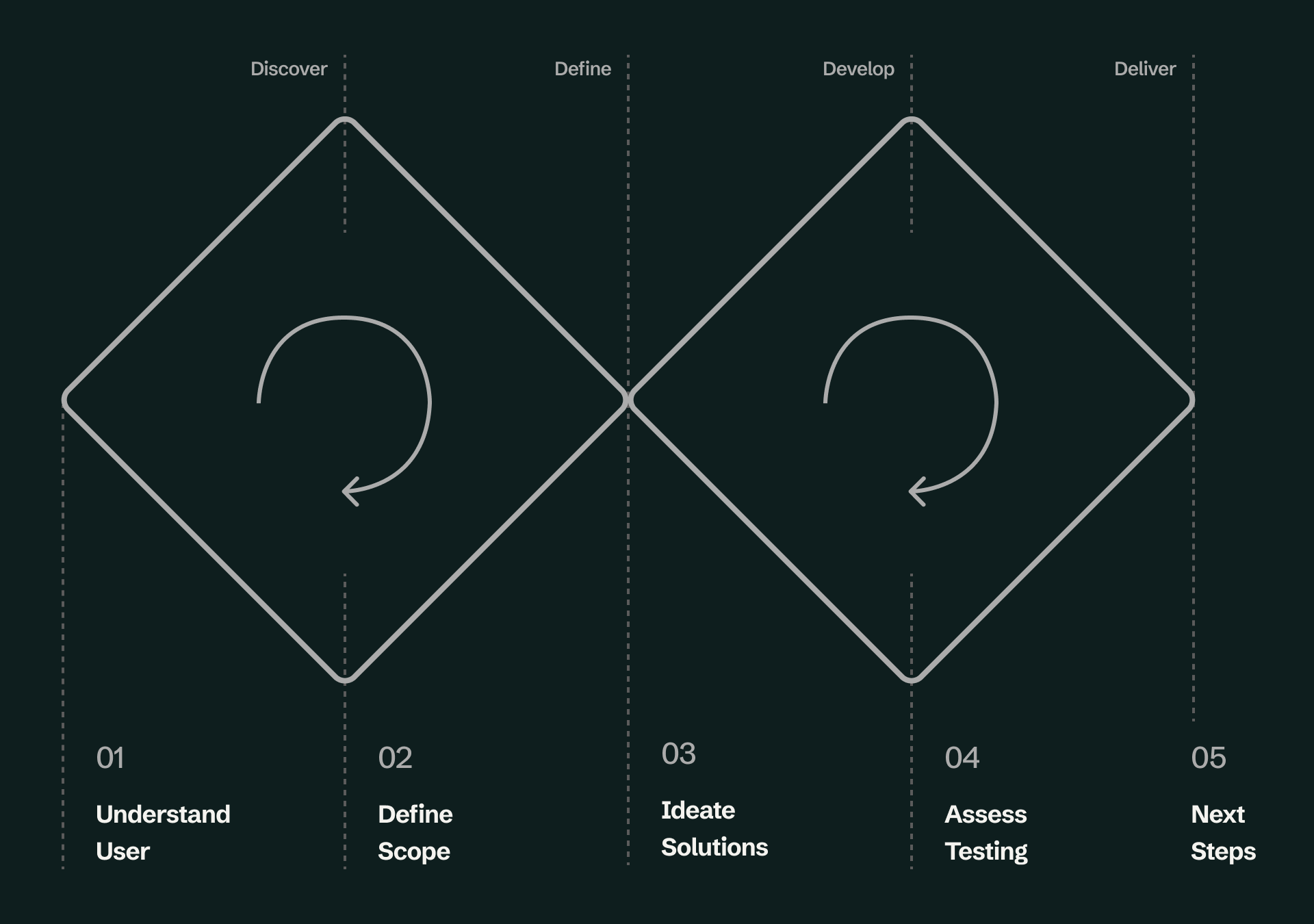
Understand User
The cost is the biggest concern for drivers to take intercity orders.
Before I joined the project, the exploratory research has been done by a researcher to discover some insights on intercity deliveries.
Insight 01
Drivers avoid intercity orders due to the lengthy delivery times, fuel expenses, lost local opportunities, and mental fatigue. They hope for return orders that allow them to get back to their original city.
Insight 02
Drivers are afraid that users will cancel, which will disarray their plans.
Insight 03
Intercity orders often require more specific requests. They don’t realize the requests beforehand and could not meet the delivery.
Define Scope
Focus on the cost
From the research insight, the most frequent and biggest pain point was the cost, so we decided to focus on the costs, including, time, money, and oppourtunity.
Constraints
- Don’t focus the demand issues, which needed to be handled by the user app team and marketing.
- Changing order allocation logics takes a huge tech effort. (Drivers normally get to choose which order to deliver.)
Hypothesis about the feature value
In order to make sure if we solve the problem, we set hypothesis.
If we reduce “costs” for drivers to complete intercity deliveries, drivers are motivated and more likely to respond and take intercity deliveries.
Ideate solutions
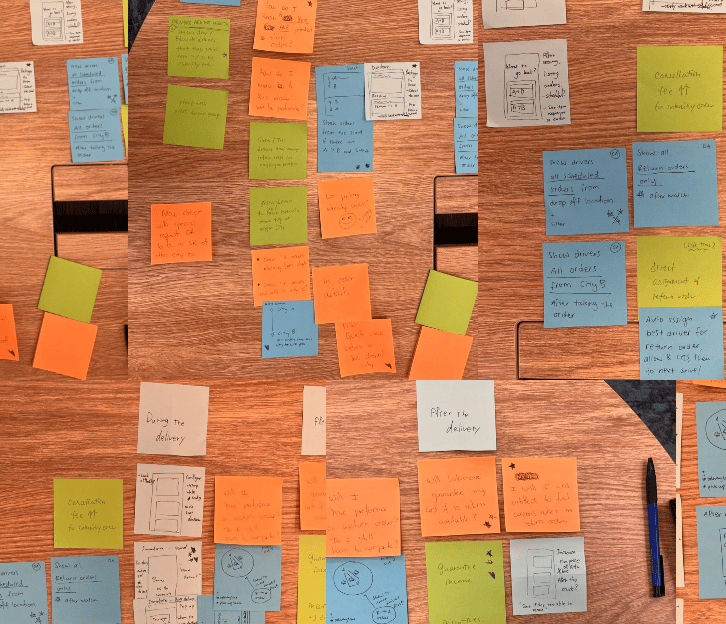
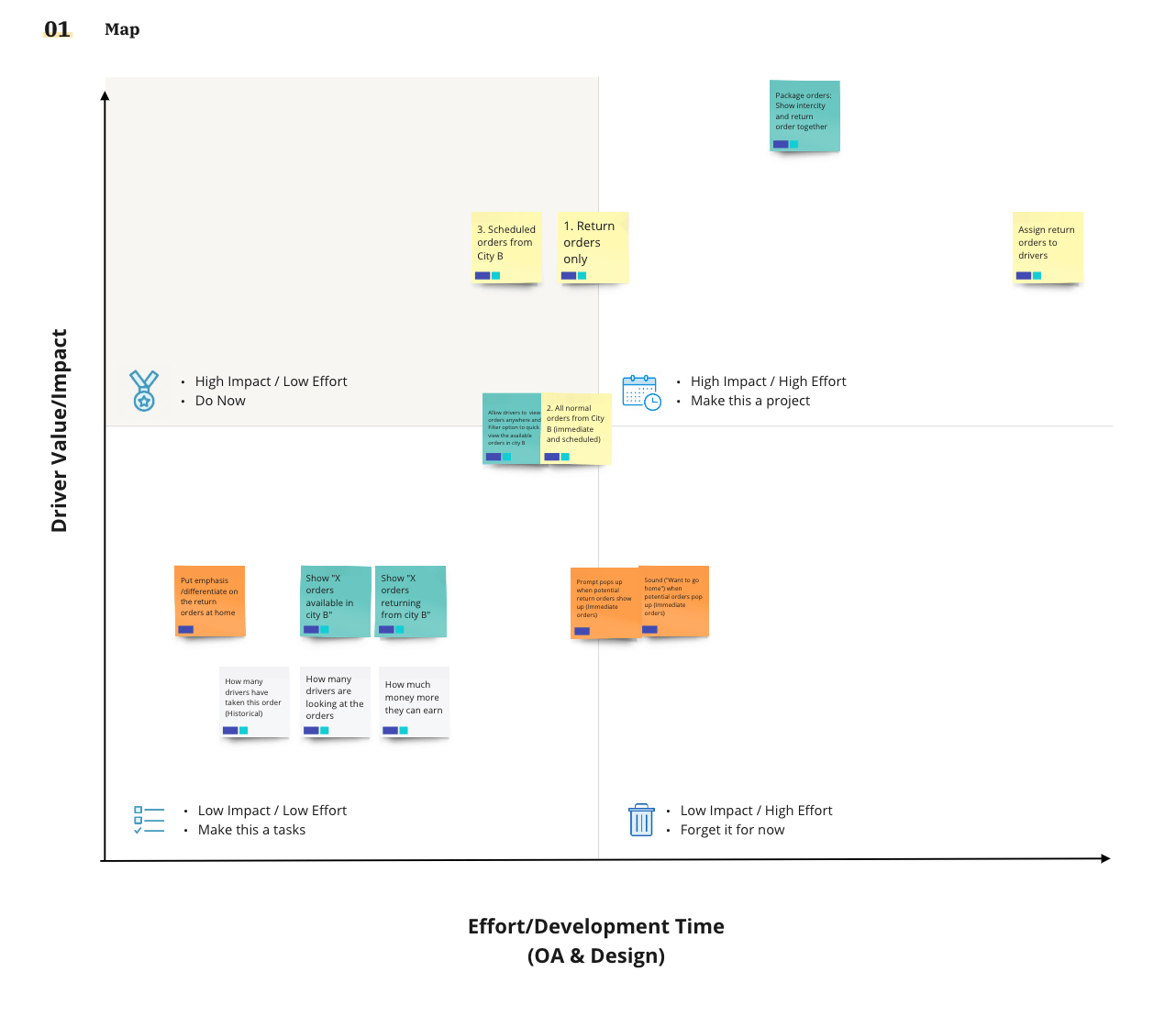
I invited key stakeholders to a workshop to come up with solutions and collaborated with them to find the most feasible and impactful solution.
- We generated as many ideas as possible.
- I grouped the similar ideas and organized into a delivery journey
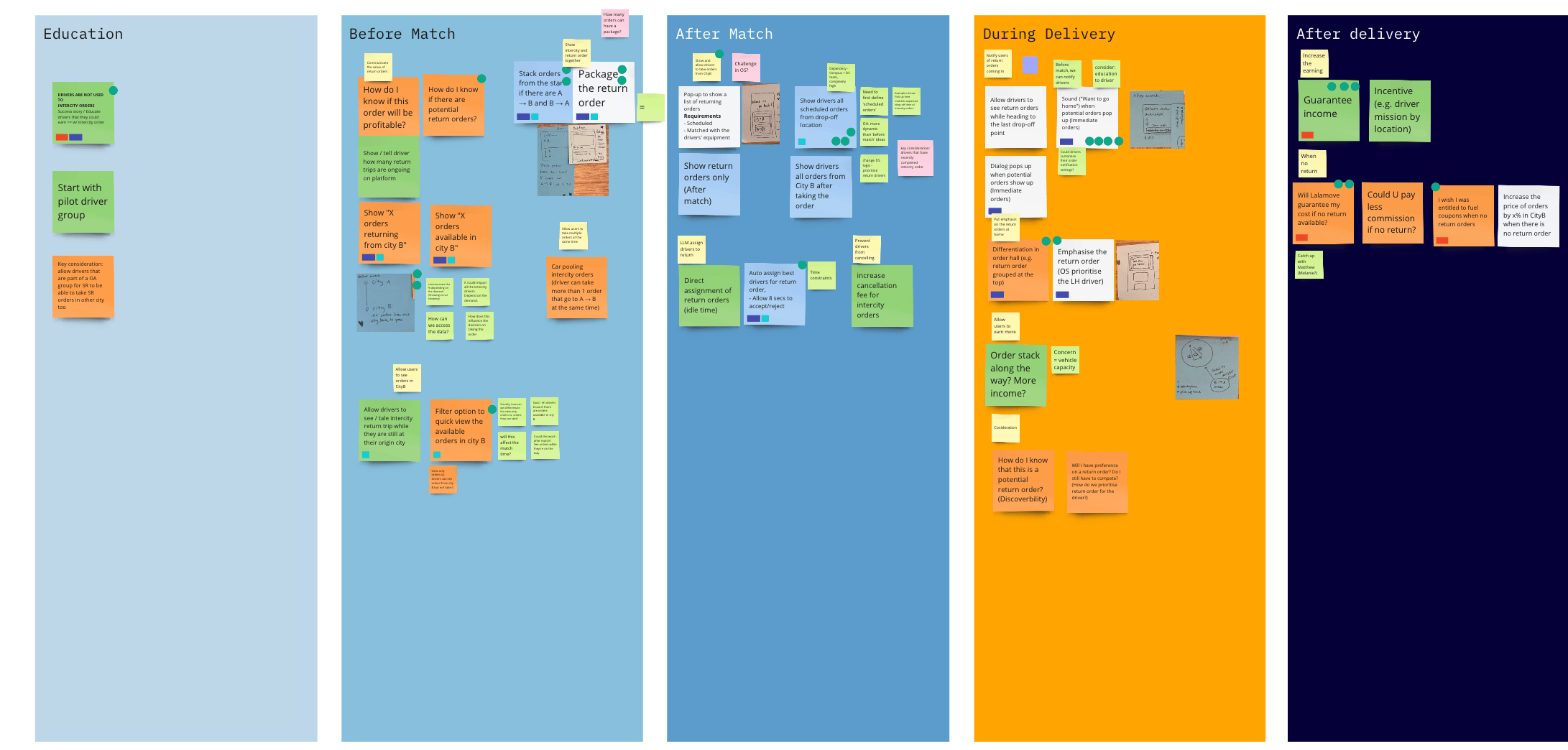
- I used the Value vs. Effort matrix and decided on which solution to deliver with the stakeholders.
Solution: Drivers with intercity orders will be able to see and take orders from the destination city
Allowing drivers to take scheduled orders from the destination will minimize the opportunity cost and help drivers earn money more efficiently.
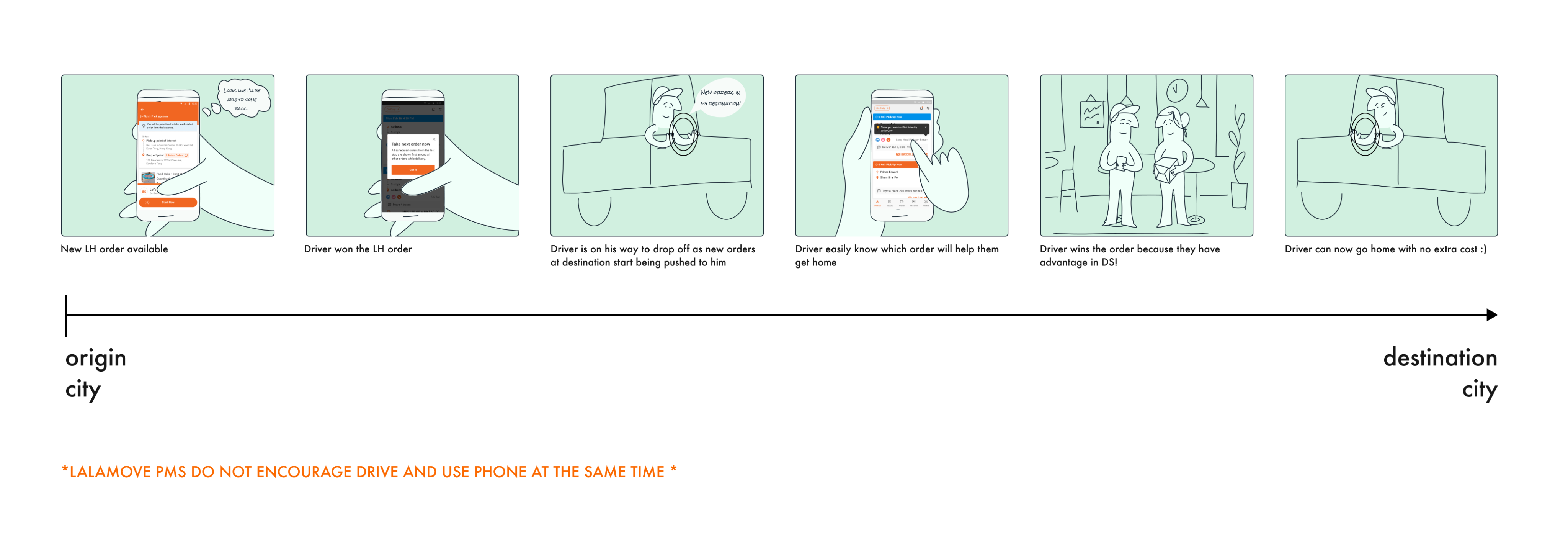
New intercity order available
Driver get the order
Driver is on his way to drop off as new orders from destination start being pushed to him
Driver easily know which order will help them take orders from destination
Driver won the order because we have advantage in the selection
Driver can do another delivery with no waste time
Design MVP
I designed MVP for the solution.
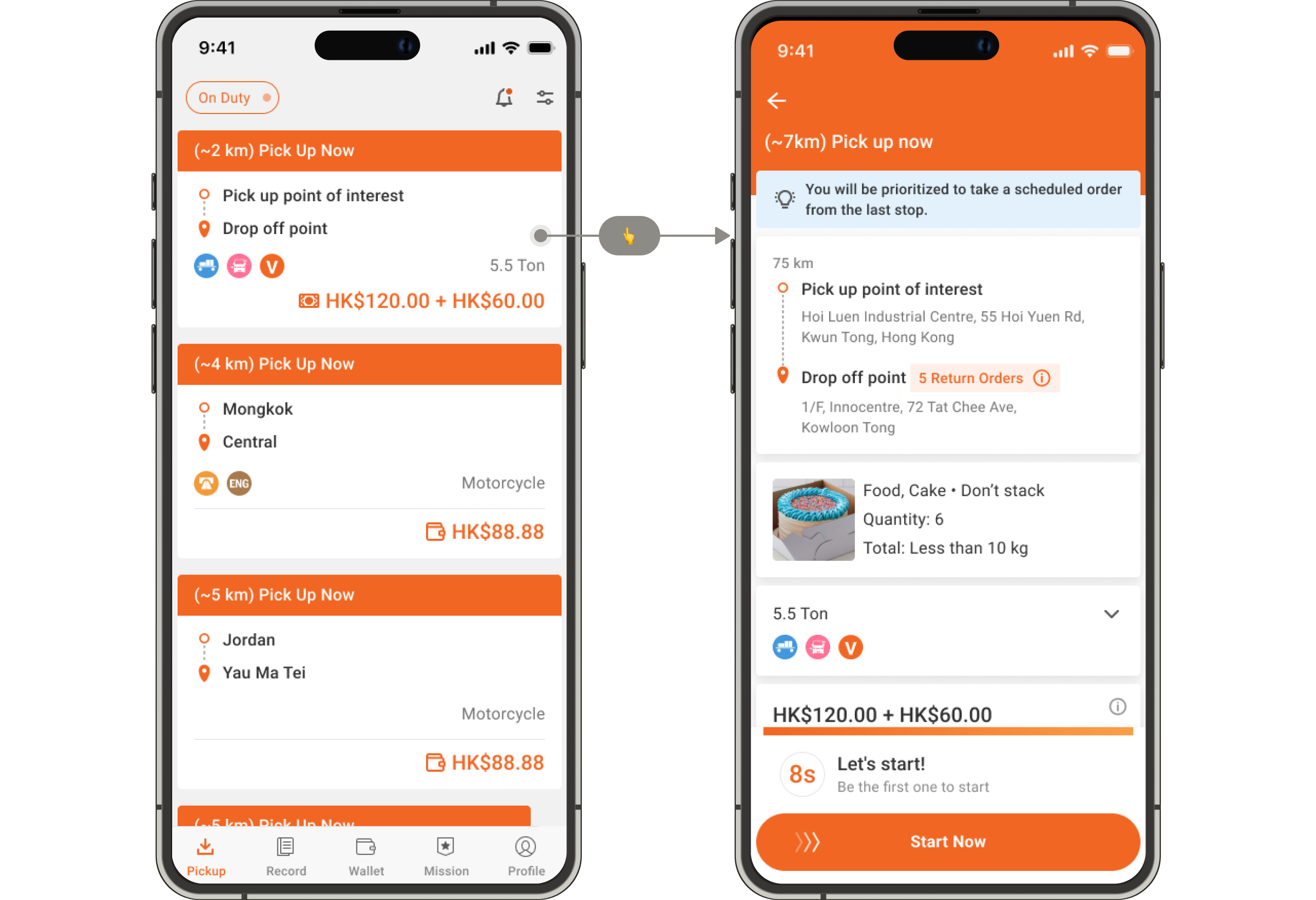
As a driver, I want to know if it’s worth taking this order, because it will take hours and fuel to deliver and will be inefficient to driver for hours to complete just one order.
Drivers are concerned about the delivery costs and efficiency. Allowing them to stacking orders from the destined city eliminates downtime spent searching for return trips after reaching their destination.
The banner with high visual gravity appears near address details when drivers make response decisions, enabling quick recognition.
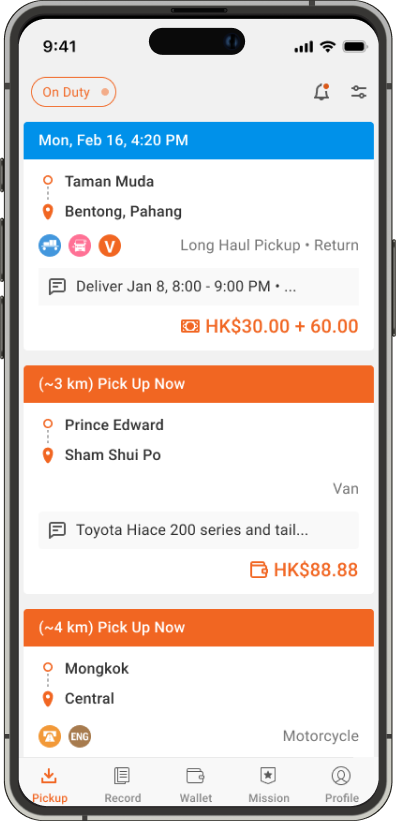
As a driver with an intercity order, I want to know if there is any order that allows me to go back to the original city.
Drivers mentioned about needs for return orders. Visualizing return orders will help them to reduce cognitive load to find which order they want to take.
The research showed drivers actively looked at the vehicle type “Long haul pickup” to find intercity orders. “Return” should be noticed by drivers when looking at the vehicle type.
Assess Testing
We launched A/B testing in two cities with most intercity orders.
Quantatitalive
↑ 3%
Increase in response rate
↑ 11%
Increase in fulfillment rate
Feedback

66% of the drivers were aware of the feature.
60% of the drivers went back to the available order list to see orders from the destination city.
60% of them would be extremely motivated to take intercity orders with return orders.
Other participants were concerned that they were not able to get matched or they did not like to plan ahead.

40% of the drivers were sometimes able to see orders from the destination city.
There were some demand issues from one city to another.
Next steps
Roll out to other markets
The increase boosted our confidence to launch the feature in cities beyond our testing locations.
Increase the order volume in order for drivers to be motivated to take intercity orders
Some drivers are actively looking for destination city orders and are motivated to take intercity orders if they can see destination city orders.
Learnings
Collaborative ideation fosters team ownership and elevates project outcomes.
Through facilitating our ideation workshop, I learned how generating diverse ideas collectively builds team ownership and creates a collaborative spirit that elevates the entire project.
Transparent communication secures leadership buy-in.
Recognizing management's high interest, I prioritized transparent communication, walking leadership through our thought process to secure buy-in.



Incentization to increase intercity delivery fulfullment
Intercity orders are more efficient to the business since the transaction value per order is higher than that of the overall order. We wanted to maximize the opportunity by ensuring drivers respond and fulfill intercity orders.
↑ 3%
Increase in response rate

↑ 11%
Increase in fulfillment rate
↑ $64K
Increase in est. annual revenue (USD)
Lalamove is an on-demand delivery platform that connects 13 million users with 1.2 million driver partners in 11 markets across the world. Lalamove driver-partner app is a tool for drivers to receive and manage delivery requests from customers.
My role
- Defined the solution with product managers through a workshop
- Designed the user interfaces and experiences for the feature
Opportunity
Though intercity orders are attractive to the business, drivers were not responding or completing the intercity orders. his issue directly impacts customer confidence in our intercity delivery service, creating an urgent need to address these fulfillment gaps.
The opportunity is
How can we attract drivers to deliver intercity orders?
Goal
The goal is to increase the revenue by increasing intercity orders.
The product manager set the goal and success metrics for this feature. We want to target:
- Increase the response rate1 of intercity orders
- Increase the fulfillment rate2 of intercity orders
- Response rate is a percentage of orders that drivers voluntarily respond to placed orders
- Fulfillment rate is a percentage of orders that drivers complete placed orders

Steps
Understand User
The cost is the biggest concern for drivers to take intercity orders.
Before I joined the feature, the exploratory research has been done by a researcher to discover some insights on intercity deliveries.
Insight 01
Drivers avoid intercity orders due to the lengthy delivery times, fuel expenses, lost local opportunities, and mental fatigue. They hope for return orders that allow them to get back to their original city.
Insight 02
Drivers are afraid that users will cancel, which will disarray their plans.
Insight 03
Intercity orders often require more specific requests. They don’t realize the requests beforehand and could not meet the delivery.
Define Scope
Focus on the cost
From the research insight, the most frequent and biggest pain point was the cost, so we decided to focus on the costs, including, time, money, and oppourtunity.
Constraints
- Don’t focus the demand issues, which needed to be handled by the user app team and marketing.
- Changing order allocation logics takes a huge tech effort. (Drivers normally get to choose which order to deliver.)
Hypothesis about the feature value
In order to make sure if we solve the problem, we set hypothesis.
If we reduce “costs” for drivers to complete intercity deliveries, drivers are motivated and more likely to respond and take intercity deliveries.
Ideate solutions
I invited key stakeholders to a workshop to come up with solutions and collaborated with them to find the most feasible and impactful solution.
- We generated as many ideas as possible.
- I grouped the similar ideas and organized into a delivery journey
- I used the Value vs. Effort matrix and decided on which solution to deliver with the stakeholders.
Solution: Drivers with intercity orders will be able to see and take orders from the destination city
Allowing drivers to take scheduled orders from the destination will minimize the opportunity cost and help drivers earn money more efficiently.
New intercity order available
Driver get the order
Driver is on his way to drop off as new orders from destination start being pushed to him
Driver easily know which order will help them take orders from destination
Driver won the order because we have advantage in the selection
Driver can do another delivery with no waste time
Design MVP
I designed MVP for the solution.
As a driver, I want to know if it’s worth taking this order, because it will take hours and fuel to deliver and will be inefficient to driver for hours to complete just one order.
Drivers are concerned about the delivery costs and efficiency. Allowing them to stacking orders from the destined city eliminates downtime spent searching for return trips after reaching their destination.
The banner with high visual gravity appears near address details when drivers make response decisions, enabling quick recognition.
As a driver with an intercity order, I want to know if there is any order that allows me to go back to the original city.
Drivers mentioned about needs for return orders. Visualizing return orders will help them to reduce cognitive load to find which order they want to take.
The research showed drivers actively looked at the vehicle type “Long haul pickup” to find intercity orders. “Return” should be noticed by drivers when looking at the vehicle type.
Assess Testing
We launched A/B testing in two cities with most intercity orders.
Quantatitalive
↑ 3%
Increase in response rate

↑ 11%
Increase in fulfillment rate
Feedback
66% of the drivers were aware of the feature.
60% of the drivers went back to the available order list to see orders from the destination city.
60% of them would be extremely motivated to take intercity orders with return orders.
Other participants were concerned that they were not able to get matched or they did not like to plan ahead.
40% of the drivers were sometimes able to see orders from the destination city.
There were some demand issues from one city to another.
Next steps
Roll out to other markets
The increase boosted our confidence to launch the feature in cities beyond our testing locations.
Increase the order volume in order for drivers to be motivated to take intercity orders
Some drivers are actively looking for destination city orders and are motivated to take intercity orders if they can see destination city orders.
Learnings
Collaborative ideation fosters team ownership and elevates project outcomes.
Through facilitating our ideation workshop, I learned how generating diverse ideas collectively builds team ownership and creates a collaborative spirit that elevates the entire project.
Transparent communication secures leadership buy-in.
Recognizing management's high interest, I prioritized transparent communication, walking leadership through our thought process to secure buy-in.


Incentivization strategy to increase intercity delivery fulfillment
Intercity orders are more efficient to the business since the transaction value per order is higher than that of the overall order. We wanted to maximize the opportunity by ensuring drivers respond and fulfill intercity orders.
↑ 3%
Increase in response rate
↑ 11%
Increase in fulfillment rate
↑ $64K
Increase in est. annual revenue (USD)
Lalamove is an on-demand delivery platform that connects 13 million users with 1.2 million driver partners in 11 markets across the world. Lalamove driver-partner app is a tool for drivers to receive and manage delivery requests from customers.
My role
- Defined the solution with product managers through a workshop
- Designed the user interfaces and experiences for the feature
Opportunity
Though intercity orders are attractive to the business, drivers were not responding or completing the intercity orders. his issue directly impacts customer confidence in our intercity delivery service, creating an urgent need to address these fulfillment gaps.
The opportunity is
How can we attract drivers to deliver intercity orders?
Goal
The goal is to increase the revenue by increasing intercity orders.
The product manager set the goal and success metrics for this feature. We want to target:
- Increase the response rate1 of intercity orders
- Increase the fulfillment rate2 of intercity orders
- Response rate is a percentage of orders that drivers voluntarily respond to placed orders
- Fulfillment rate is a percentage of orders that drivers complete placed orders

Steps
Understand User
The cost is the biggest concern for drivers to take intercity orders.
Before I joined the project, the exploratory research has been done by a researcher to discover some insights on intercity deliveries.
Insight 01
Drivers avoid intercity orders due to the lengthy delivery times, fuel expenses, lost local opportunities, and mental fatigue. They hope for return orders that allow them to get back to their original city.
Insight 02
Drivers are afraid that users will cancel, which will disarray their plans.
Insight 03
Intercity orders often require more specific requests. They don’t realize the requests beforehand and could not meet the delivery.
Define Scope
Focus on the cost
Our research highlighted cost as drivers' biggest pain point. We'll tackle this critical issue first, while addressing other issues, such as the frustrations about accommodating customer request through separate projects.
Constraints
- Don’t focus the demand issues, which needed to be handled by the user app team and marketing.
- Changing order allocation logics takes a huge tech effort. (Drivers normally get to choose which order to deliver.)
Hypothesis about the feature value
In order to make sure if we solve the problem, we set hypothesis.
If we reduce “costs” for drivers to complete intercity deliveries, drivers are motivated and more likely to respond and take intercity deliveries.
Ideate solutions
I invited key stakeholders to a workshop to come up with solutions and collaborated with them to find the most feasible and impactful solution.
- We generated as many ideas as possible.
- I grouped the similar ideas and organized into a delivery journey
- I used the Value vs. Effort matrix and decided on which solution to deliver with the stakeholders.
Solution: Drivers with intercity orders will be able to see and take orders from the destination city
Allowing drivers to take scheduled orders from the destination will minimize the opportunity cost and help drivers earn money more efficiently.
New intercity order available
Driver get the order
Driver is on his way to drop off as new orders from destination start being pushed to him
Driver easily know which order will help them take orders from destination
Driver won the order because we have advantage in the selection
Driver can do another delivery with no waste time
Design MVP
I designed MVP for the solution.
As a driver, I want to know if it’s worth taking this order, because it will take hours and fuel to deliver and will be inefficient to driver for hours to complete just one order.
Drivers are concerned about the delivery costs and efficiency. Allowing them to stacking orders from the destined city eliminates downtime spent searching for return trips after reaching their destination.
The banner with high visual gravity appears near address details when drivers make response decisions, enabling quick recognition.
As a driver with an intercity order, I want to know if there is any order that allows me to go back to the original city.
Drivers mentioned about needs for return orders. Visualizing return orders will help them to reduce cognitive load to find which order they want to take.
The research showed drivers actively looked at the vehicle type “Long haul pickup” to find intercity orders. “Return” should be noticed by drivers when looking at the vehicle type.
Assess Testing
We launched A/B testing in two cities with most intercity orders.
Quantitative outcome
↑ 3%
Increase in response rate
↑ 11%
Increase in fulfillment rate
Feedback
66% of the drivers were aware of the feature.
60% of the drivers went back to the available order list to see orders from the destination city.
60% of them would be extremely motivated to take intercity orders with return orders.
Other participants were concerned that they were not able to get matched or they did not like to plan ahead.
40% of the drivers were sometimes able to see orders from the destination city.
There were some demand issues from one city to another.
Next steps
Roll out to other markets
The increase boosted our confidence to launch the feature in cities beyond our testing locations.
Increase the order volume in order for drivers to be motivated to take intercity orders
Some drivers are actively looking for destination city orders and are motivated to take intercity orders if they can see destination city orders.
Learnings
Collaborative ideation fosters team ownership and elevates project outcomes.
Through facilitating our ideation workshop, I learned how generating diverse ideas collectively builds team ownership and creates a collaborative spirit that elevates the entire project.
Transparent communication secures leadership buy-in.
Recognizing management's high interest, I prioritized transparent communication, walking leadership through our thought process to secure buy-in.


